


Italy is a boot-shaped peninsula surrounded by the Mediterranean Sea, with the Alps in the North and the subtropical islands of Sicily and Sardinia to the South. Italy traces its roots back two millennia to the Etruscans. The Roman Empire, one of the most influential in world history, was established in 31 BC by Augustus Caesar. At its height, the empire included much of Europe, North Africa, and the Middle East. In addition to its imperial prowess, the Roman Empire is known for innovations in engineering and architecture, republican governance, and for being the birthplace of the civil (Roman) law system. During the Renaissance period (15th and 16th centuries), Italy was a collection of independent city states, each with its own government and wealthy patrons who supported groundbreaking contributions to the arts, sciences, and literature in cities like Florence, Milan, and Venice.
Italy became a single nation in 1861 when Giuseppe Garibaldi led the “Risorgimento” (unification) movement. In 1871, Rome replaced Florence as the capital city. When World War I began, Italy initially declared neutrality, despite its earlier alliance with Germany and the Austro-Hungarian Empire, and ultimately joined the Allies in 1915. After the war, the country faced dire economic conditions, leading to social unrest and the rise of nationalism. Benito Mussolini came to power in 1922 and transformed the country into a fascist dictatorship that aligned with Nazi Germany during World War II. Mussolini was overthrown in 1943 and executed by partisans in 1945. After the war, a popular referendum abolished the monarchy and the modern Italian state was established on June 2, 1946. Italy is composed of 20 administrative regions, five of which have special status and greater autonomy. Two independent states, Vatican City and the Republic of San Marino, sit within its borders.

Legal System
Italy is a parliamentary republic. The prime minister leads the government; the president serves as ceremonial head of state and appoints the prime minister. Parliament is has two houses: the Chamber of Deputies and the Senate of the Republic. Italy’s judges and prosecutors are collectively known as “magistrates,” in keeping with the Roman law tradition; they are governed by a single administrative entity, the High Council of the Judiciary (Consiglio Superiore della Magistratura).
The Courts
Each of Italy’s 20 regions constitutes a judicial district with its own first instance courts, court of appeal, and specialized tribunals. Larger regions may have more than one district making the total number of judicial districts 26. As in many other countries, the Constitutional Court operates independently of the national judiciary.
First instance courts are divided into three tiers:

Justices of the Peace (“Giudice di Pace”)
Minor civil and criminal matters are handled by Justices of the Peace (“Giudice di Pace”), non-career judges appointed by the High Council of the Judiciary for renewable four-year-terms. Justices of the Peace must have a law degree but are not subject to the rigorous appointment process required for other judges.
Ordinary Courts (“Tribunali Ordinari”)
More complex civil and criminal cases are heard by the Ordinary Courts (“Tribunali Ordinari”). Cases in these courts are adjudicated by a single judge or, for more complex matters, a panel of three judges.
Assize Courts (“Corte d’Assize”)
Serious felonies - homicide, human trafficking, and offenses punishable by 24 years or life imprisonment - are adjudicated in the Assize Court (“Corte d’Assize”). Mixed panels composed of two professional judges and six lay jurors (“giudici popolari”) preside over felonies. Lay jurors are chosen randomly from lists of registered voters with no criminal record who are between the age of 30-65 years. Their deliberations and votes are accorded equal weight to those of the judges.
Justices of the Peace (“Giudice di Pace”)
Minor civil and criminal matters are handled by Justices of the Peace (“Giudice di Pace”), non-career judges appointed by the High Council of the Judiciary for renewable four-year-terms. Justices of the Peace must have a law degree but are not subject to the rigorous appointment process required for other judges.
Ordinary Courts (“Tribunali Ordinari”)
More complex civil and criminal cases are heard by the Ordinary Courts (“Tribunali Ordinari”). Cases in these courts are adjudicated by a single judge or, for more complex matters, a panel of three judges.
Assize Courts (“Corte d’Assize”)
Serious felonies - homicide, human trafficking, and offenses punishable by 24 years or life imprisonment - are adjudicated in the Assize Court (“Corte d’Assize”). Mixed panels composed of two professional judges and six lay jurors (“giudici popolari”) preside over felonies. Lay jurors are chosen randomly from lists of registered voters with no criminal record who are between the age of 30-65 years. Their deliberations and votes are accorded equal weight to those of the judges.
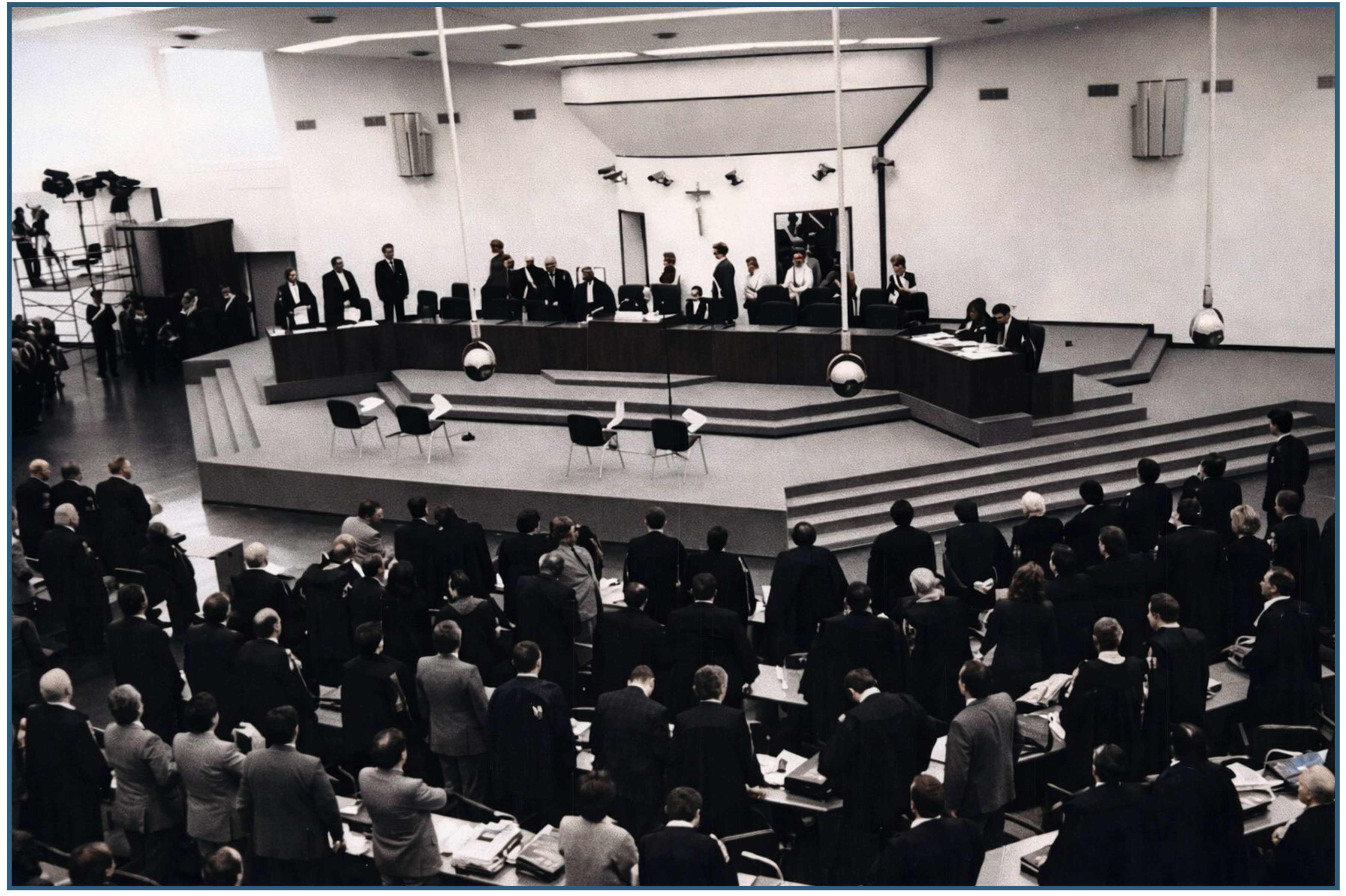 The Maxi-Trial (Maxiprocesso)
One of the largest recorded criminal prosecutions (by number of defendants) took place in Palermo from 1986 - 1992. The “Maxi-Processo” involved the prosecution of 475 members of the Sicilian Mafia. Proceedings were held in a special courtroom built within the Ucciardone Prison; the courtroom was equipped with armored doors, bulletproof glass, and a special ceiling to protect against airstrikes. A mixed panel of judges and lay jurors deliberated in isolation for 36 days before reaching a verdict.
The Maxi-Trial (Maxiprocesso)
One of the largest recorded criminal prosecutions (by number of defendants) took place in Palermo from 1986 - 1992. The “Maxi-Processo” involved the prosecution of 475 members of the Sicilian Mafia. Proceedings were held in a special courtroom built within the Ucciardone Prison; the courtroom was equipped with armored doors, bulletproof glass, and a special ceiling to protect against airstrikes. A mixed panel of judges and lay jurors deliberated in isolation for 36 days before reaching a verdict.
Court of Appeal ("Corte d'Appello")
There is a court of appeal in each regional capital city that reviews cases from the Justices of the Peace and Ordinary Courts. Some of the larger regions (such as Sicily and Puglia) have multiple districts, each with its own appellate court. Most appeals are heard by three-judge panels. On the initial appeal, the court may re-examine both facts and legal issues. However, the scope of this review is limited to the evidence and legal arguments presented during the first instance proceedings. Cases involving minors are heard by an appellate panel composed of two judges and two experts, typically psychologists or social workers.
Courts of Appeal for the Assizes Court (“Corte d'Assise d'Appello”)
The Assizes Courts of Appeal review cases from the Assizes Courts and are usually located in the regional capital. As is the case with the first instance Assizes Court, appeals are heard by a mixed panel of two judges and six lay jurors. As is the case in some (but not all) civil law jurisdictions, the prosecution in Italy may appeal an acquittal.
The Court of Appeal for the Assizes Court reviews both the evidence and legal arguments presented at the first trial. The court may consider new evidence if it determines:
- the existing evidence is insufficient to reach a judgment,
- evidence that was available but not introduced during the first trial, is “absolutely necessary,” or
- new evidence is discovered post-conviction and is relevant and decisive.
Decisions regarding the admission of new evidence are made by the court's mixed panel of two professional and six lay judges after hearing arguments addressing this question from both the defense and the prosecution.
Transition to Adversarial Proceedings
 In 1988, Italy, a civil law country that historically followed the inquisitorial model, amended the rules of criminal procedure to introduce adversarial-style procedures in criminal cases. The reforms authorized expanded use of oral testimony during trials and shifted responsibility for presenting evidence and questioning witnesses from the judge to the prosecutor and defense counsel. Cross-examination was introduced and the use of written pretrial statements recorded outside the presence of counsel was restricted. Two additional case management reforms were implemented: plea bargaining and abbreviated trials. Prosecutors and defense counsel were permitted to negotiate for a reduced sentence in exchange for a guilty plea, the terms of which are subject to judicial review. A related reform enabled the accused to opt for a bench trial based on the evidence in the investigative file in exchange for a reduced sentence.
Specialized Courts
Each region of Italy has three types of specialized courts:
- Tax Courts have jurisdiction over disputes related to regional, provincial, and municipal taxes as well as contributions paid to the national health service.
- The military courts have exclusive jurisdiction over offenses committed by members of the armed forces.
- Administrative courts adjudicate claims made by individuals or organizations against the government and public bodies, including cases involving urban planning decisions, public contracts, licenses, and government hiring.
Appeals from the first instance tax and military courts are heard by specialized appellate courts. Appeals from the specialized tax and military appellate courts are reviewed by the Supreme Court of Cassation. Appeals from the first instance administrative courts are reviewed by the Council of State (“Consiglio di Stato”).
The Supreme Court of Cassation (“Corte Suprema di Cassazione”)
The Supreme Court of Cassation is the final court of appeal. Review is limited to questions of law and procedural errors unless one of the following exceptions exist:
- “Revocation” (“revocazione”): the court may review a judgment based on a manifest factual error that is clearly evident from the existing trial record and was decisive to the verdict, or
- “Revision” (“revisione”): new evidence emerges that may be exculpatory

Although Italy’s Constitution guarantees appeal to the Court of Cassation, in practice the court exercises considerable discretion in managing its docket through a filtering mechanism. During a preliminary screening process, appeals found to be "manifestly unfounded" or fail to raise a valid point of law may be dismissed.
The Court of Cassation is organized into six civil and seven criminal divisions. There is also a “united” division that is convened as needed to adjudicate especially complex cases or to resolve conflicting interpretations of the same legal question by the court’s other divisions. Cases in the civil and criminal divisions are heard by panels of five judges; cases presented to the united section are heard by a nine-judge panel.
The Court of Cassation is composed of approximately 370 judges. This includes the presiding judge (“Primo Presidente”), one deputy president, presiding judges that chair the court’s divisions, and judges assigned to the divisions. The court also has “supporting judges,” lower-court judges selected by the High Council of the Judiciary to provide research and drafting support in complex cases.
There are two paths to becoming a judge on the Court of Cassation. Most are appointed by the High Council of the Judiciary after a lengthy evaluation process that considers competence and diligence. Candidates must have at least 16 years of experience as a judge with a strong record of excellence. The nominees are initially assessed by an appointments committee that sends its recommendations to the full Council. One-tenth of the court's members are drawn from outside the judiciary, including from academia and the bar. For a lawyer to be considered, they must have at least 15 years of experience litigating cases in the higher courts.
Although Italy’s Constitution guarantees appeal to the Court of Cassation, in practice the court exercises considerable discretion in managing its docket through a filtering mechanism. During a preliminary screening process, appeals found to be "manifestly unfounded" or fail to raise a valid point of law may be dismissed.
The Court of Cassation is organized into six civil and seven criminal divisions. There is also a “united” division that is convened as needed to adjudicate especially complex cases or to resolve conflicting interpretations of the same legal question by the court’s other divisions. Cases in the civil and criminal divisions are heard by panels of five judges; cases presented to the united section are heard by a nine-judge panel.
The Court of Cassation is composed of approximately 370 judges. This includes the presiding judge (“Primo Presidente”), one deputy president, presiding judges that chair the court’s divisions, and judges assigned to the divisions. The court also has “supporting judges,” lower-court judges selected by the High Council of the Judiciary to provide research and drafting support in complex cases.
There are two paths to becoming a judge on the Court of Cassation. Most are appointed by the High Council of the Judiciary after a lengthy evaluation process that considers competence and diligence. Candidates must have at least 16 years of experience as a judge with a strong record of excellence. The nominees are initially assessed by an appointments committee that sends its recommendations to the full Council. One-tenth of the court's members are drawn from outside the judiciary, including from academia and the bar. For a lawyer to be considered, they must have at least 15 years of experience litigating cases in the higher courts.
Judicial Selection and Tenure
Italy has a career judiciary. Candidates for the ordinary and assize courts must have a law degree and pass a competitive public examination (written and oral). In most exam cycles, only 10% of applicants pass. Applicants for positions on specialized courts take an exam tailored to the court’s field of law. After passing the exam, candidates participate in an 18-month training program at the National School for the Judiciary (“Scuola Superiore della Magistratura”) followed by rotations in the courts and prosecution offices. During this apprenticeship, candidates are evaluated and may be dismissed for inadequate performance. After a final review by the High Council of the Judiciary, candidates are eligible for appointment to the magistracy by presidential decree.
New magistrates may express a preference for assignment to the courts or the prosecution service; however the needs of the magistracy will be determinative in their appointment. Moving between the judiciary and procuracy is possible, but not common and must be approved by the High Council. Newly appointed judges first serve as a judicial auditor (uditore giudiziario) and are later elevated to the position of judge (magistrato ordinario).
Appointment to the courts of appeal are based on a combination of seniority and merit. Judges interested in being elevated may apply to the High Council when a vacancy is announced. The Council’s Evaluation Committee reviews the applicant’s record of performance and evaluation reports. The President of the Republic formally appoints successful candidates. Most applicants for a position on a court of appeals have 7 – 13 years of experience as a first instance judge. However, in 2025 Italy’s appellate courts experienced critical vacancies; emergency legislation was passed waiving the standard seniority requirements.
The mandatory retirement for all magistrates (first instance and appellate) is 70.
Constitutional Court (“Corte Costituzionale”)
 The Constitutional Court is independent of the regular court system. Its jurisdiction includes constitutional review of state and regional laws; jurisdictional disputes between branches of the central government or between the state and the regions; and cases involving charges of high treason against the President of the Republic.
Constitutional Court (“Corte Costituzionale”)
The Constitutional Court is independent of the regular court system. Its jurisdiction includes constitutional review of state and regional laws; jurisdictional disputes between branches of the central government or between the state and the regions; and cases involving charges of high treason against the President of the Republic.
There are two ways for a case to reach the Constitutional Court. Under Incidental Procedure (“Via Incidentale”), lower court judges may request review of the constitutionality of a law that is essential to resolving a case before them. Under Principal Procedure (“Via Principale”), the national government may challenge a regional law as exceeding regional authority or a region may challenge a national law as infringing upon its autonomy.
The Constitutional Court has 15 judges, each appointed to a non-renewable nine-year term. An equal number (five) of the court’s judges is selected by each of the following: the President of the Republic; the Parliament in joint session; the ordinary courts (3 seats) and the administrative courts (2 seats). Constitutional Court judges may serve past the age of 70 if necessary to finish their nine-year term.
High Council of the Judiciary ("Consiglio Superiore della Magistratura")
The High Council of the Judiciary is responsible for the appointment, promotion, assignment, transfer, and oversight (conduct and discipline) of judges and prosecutors. The Council’s thirty members serve non-renewable four-year terms. Two-thirds are elected by magistrates and one-third are elected by Parliament. The President of the Republic, the First President of the Court of Cassation, and the Prosecutor General of Court of Cassation serve as ex-officio members.
On October 30, 2025, the Italian Parliament approved a proposed constitutional amendment proposing a reform that would have significantly changed the structure of Italy’s magistracy and the jurisdiction of the High Council. The amendment sought to introduce distinct career paths for judges and prosecutors, assign each professional entity its own High Council, and establish a new disciplinary court. Proponents argued that the proposed reform would strengthen the judiciary’s impartiality and transparency, while critics expressed concerns about threats to prosecutorial independence and constitutional protections. In March 2026, voters rejected the amendment in a nationwide referendum.
Council of State ("Consiglio di Stato")
The Council of State serves dual roles: it sits as an advisory body for the government and also serves as both the intermediate appellate court and the final court of appeal for administrative law cases. In its advisory capacity, the Council reviews draft legislation and regulations promulgated by the government and its ministries to ensure that they comply with primary laws and administrative procedure. The Council has 104 judges. They are appointed by the President based upon recommendations from the Council of Ministers; candidates and are drawn from the lower administrative court, a public competition, and other government offices, the bar, or academia.

Case Management Reforms
Italy’s court system struggles with significant delays. In 2021 and 2022, legislation was passed to facilitate improved case disposition targets. Reform measures included digitization of case files, new procedural rules to streamline trials, better training for support staff, use of alternative dispute resolution, and the imposition of a higher preliminary standard of proof in criminal cases to discourage prosecutors from filing weak cases. In addition, the President of the Court of Cassation was authorized to assign up to 50 magistrates from its research offices to temporarily assume judicial duties and help clear backlogs.
