
History
The first nation to implement a socialist law system was the Soviet Union (USSR). With state-planned economic production, the Bolsheviks believed that there would be no need for a formal legal system. In the 1920’s they replaced Tsarist legal institutions, including the courts, with a dual system of local people’s courts and revolutionary tribunals. However, when the new Soviet state was tasked with combatting economic disorder, it restored many Tsarist institutions to manage social conflict and facilitate industrialization, including the procuracy and a centralized court system.
After World War II, the USSR dispatched lawyers to newly formed Soviet republics and allied socialist states to advise on the integration of socialist principles into existing legal frameworks. A family of legal systems emerged in the mid-20th century that shared three primary components: economic (centrally planned economies), ideological (the belief that law is an instrument to express the will of the working classes), and political (centralized power in a single-party state).
Key Features of the Socialist Legal Tradition
Constitutions
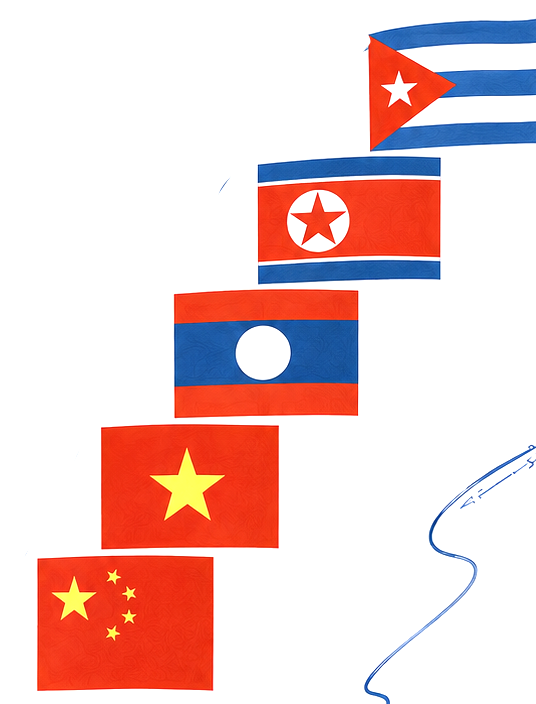
Most socialist legal systems have a constitution. However these legal regimes do not resemble constitution-based democracies that, following the writings of Montesquieu, enshrine the separation of governmental powers. Grounded in Leninist democratic centralism and the supremacy of the Communist Party, socialist constitutions allow for the concentration of state power. The USSR Constitution of 1936 enshrined the Communist Party as the driving force for the state and continues to serve as a model for socialist countries around the world. Article 5 of the Cuban Constitution of 2019, for example, explicitly names the Communist Party of Cuba as the country’s preeminent political entity, standing above all branches of government.
Another feature of socialist constitutions is their incorporation of social entitlements including the right to work, health care, and housing. Similar “positive rights” are enshrined in both post-socialist constitutions (for example, Ukraine’s 1996 constitution) and the constitutions of South Africa, the Philippines, India, and Brazil, among others.
Legislative Process

Under socialist law, legislative power is usually concentrated in a single entity, known as the supreme state organ of power. Article 32 of the 1936 USSR Constitution, for example, vests all legislative power in the All-Union Supreme Soviet. De facto control over the Supreme Soviet resided in the Communist Party Politburo. Similarly, the constitutions of Cuba and Vietnam have unicameral legislatures, the National Assembly of People’s Power and the National Assembly of Vietnam. While most legislation in socialist law regimes is publicly promulgated (such as the USSR five-year economic plans), they also may have administrative directives that are not.
Property and Contracts
The transition to socialism is typically accompanied by land reforms, including the seizure of property, the imposition of common ownership over productive assets, and modest private ownership rights in personal property. The 1922 Civil Code of Soviet Russia, for example, set forth property law norms but with a new hierarchy: state and social property were at the top, followed by personal property, and finally limited forms of private property.
In many socialist law systems, contracts were imposed on state-owned entities by a central plan. Most contractual disputes became matters of public policy. In the 1970s and 1980s, as some socialist countries began to introduce elements of a market economy, command-style economic systems became less feasible. For example, during this period in China, property and contract law were modified to allow private individuals to enter contracts involving land and, over time, commerce.
Criminal Justice
Political and Ideological Crimes
Socialist law regimes may separate ‘social’ and ‘political’ crimes from ordinary criminal offenses and sanction conduct deemed ‘antisocial’ or antithetical to state interests. In China, while the category of ‘counterrevolutionary’ crimes was abolished in 1997, criminal conduct such as ‘sabotaging national unity’ is codified in sections of the criminal code as ‘endangering state security.’ North Korea also reclassified ‘anti-revolution’ crimes as ‘anti-state crimes,’ a provision that criminalizes acts, speech, or beliefs that threaten national sovereignty. In the USSR, criminal sanctions reflected state ideology: theft of state and collective property was initially punished more harshly than theft of personal property and certain crimes were elevated in severity including evading work, tardiness, truancy, and changing jobs without authorization. Political crimes were investigated by Soviet secret police and adjudicated by special court panels, with state-vetted attorneys serving as defense.
Procuracy
In socialist legal systems, the procuracy is closely tied to the communist party and serves two roles. It is the public prosecutor in criminal cases and oversees state administrative actions and state-owned enterprises through audits and administrative sanctions. Communist parties also use the procracy to operate a separate system of punishment for Party members.
In China, the People’s Procuratorate has both a prosecutorial and supervisory role. The Supreme People’s Procuratorate (SPP) is the highest prosecuting authority and reports directly to the National People’s Congress. It sets criminal justice policy and serves as public prosecutor in serious criminal cases including those involving national security. There are also specialized procuratorates, including one for the military. The Office of the Supreme People’s Prosecutor in Laos plays a similar role: it supervises criminal investigations and prosecutions, monitors the uniform enforcement of the constitution as well as the legality of court proceedings, and regulates detention centers, prisons, and re-education centers.
Courts and Trials
Under the principle of democratic centralism, all adjudicative bodies are instruments of government policy and serve to consolidate power in the central state. The judiciary generally adjudicates civil and criminal cases, special tribunals adjudicate disputes between state-owned firms, and the procuracy retains oversight of administrative disputes.
The judiciary in socialist law systems is supervised by the supreme state organ of power and communist party leadership. However, courts may wield significant discretionary power. For example, courts may have the authority to dismiss suits before their existence is noted on a public docket and, as is the case in China, may address issues not directly presented in the litigation if doing so is in furtherance of the orderly administration of justice.
The use of lay assessors – ordinary citizens who help decide cases alongside judges – is another common feature of socialist law. The Soviet Union re-introduced mixed professional-lay benches in the early 1920s after a period of reliance on non-legally-trained citizens to adjudicate disputes. Lay assessors in China are accorded equal authority to a judge, a reform implemented in 2018. Vietnam also has “peoples assessors” that participate in first instance civil and criminal proceedings.
The Evolution of Socialist Law in Central and Eastern Europe
After World War II, socialist law was adopted by the new Soviet Socialist Republics as well as allied states like Yugoslavia. However, over time, public demands for individual rights and economic development led to reforms. For example, Yugoslavia restored independent judicial review over administrative actions in 1952. After Stalin’s death in 1953, more Soviet republics followed, including Hungary in 1957, Romania in 1967, and Bulgaria in 1970. The final Soviet Constitution of 1977 provided for judicial review of all administrative decisions. Other reforms included new institutions designed to safeguard civil rights, like the office of the ombudsman which was established in Poland in 1987 and later in other Eastern European countries.
After the dissolution of the Soviet Union, countries in this region ratified new constitutions enshrining freedom of speech and assembly, independent judiciaries, and constitutional courts. But many retained protections for certain social rights. In the 1990s courts in Hungary and Russia ruled that legislatively imposed austerity measures implemented by the new governments violated constitutionally guaranteed social rights.
Country Examples
China
China’s 1954 Constitution was significantly influenced by the 1936 USSR Constitution. During the Cultural Revolution, the Chinese Communist Party (CCP) moved away from formal legal institutions. After Mao’s death, China reinstituted the court system, restored the procuracy, and, in 1982, drafted a new constitution that enshrined democratic centralism. Legal reforms of this era included changes to property and contract law, including enabling private property interests in some types of movable assets and residential homes. Contemporary Chinese law retains many socialist law elements including the primacy of the CCP and the National People’s Congress, administrative punishment, and centralized institutional supervision.
Cuba
After the Cuban Revolution of 1959, the new ruling Communist Party instituted land reforms, abolished rental housing, and transferred ownership of these homes to tenants. Although Cuba retained the Spanish Civil Code of 1889, it was amended hundreds of times after the Revolution and finally replaced in 1987. The Cuban Civil Code of 1987 aligned the country’s legislation with its socialist Constitution of 1976, including provisions related to personal property. Under this legal regime, individuals who permanently leave Cuba were barred from inheriting personal property, limits were placed on how much personal property individuals could own, and claims to property acquired by exploiting the labor of another person were not recognized. Cuba’s current 2019 constitution introduced significant reforms, including recognizing, for the first time, private (not just personal) property. Although the 2019 constitution affirms the preeminent role of the Communist Party, it notes the role of an open market in a “socialist” economy, separates the role of Head of State (president) from Head of Government (prime minister), and sets forth some due process protections in criminal trials.
Laos
After gaining independence from France in 1955, Laos remained a constitutional monarchy until 1975, when the communist Lao People’s Revolutionary Party, which was closely aligned with Vietnam, came to power. The inherited French civil code was modified to integrate Laoation customary law. The 1991 constitution introduced a “socialist oriented” market economy, retaining the preeminance of a single-party state but allowing for some private enterprise and foreign investment. Laos amended its constitution in 2025 to enable more independent local governance and create a constitutionally sanctioned national public auditor to investigate corruption and provide greater accountability.
North Korea
North Korea has had five constitutions. The first, enacted in 1948, was a close copy of the constitution of the USSR, even establishing the rights of North Korea's ethnic minorities although there are no ethnic minorities in the country. The constitution also recognized nominal individual liberties such as freedom of speech and religion as well as protections against arbitrary arrest and detention. By the time the second constitution was drafted in 1972, the Korean Workers’ Party’s (KWP) power was fully consolidated under one leader, Kim Il Sung. This constitution created a uniquely North Korean style of socialism, enshrining the Juche ideology of self-reliance as the country’s guiding principle.
The 1992 constitution facilitated the hereditary succession of Kim Jong Il, and the 1998 constitution consolidated his power. The 2009 constitution guaranteed that governing authority would pass to Kim Jong Il’s own son, Kim Jong Un. Notably, it removed mention of Marxist-Leninism and communism, now deemed to be foreign concepts. North Korea’s courts apply legal interpretations promulgated by the supreme state organ of power, the Supreme People’s Assembly, which is itself controlled by the KWP. Judges face criminal liability if they diverge from official interpretations of the law as promulgated by the Presidium of the Supreme People’s Assembly. Political prosecutions are adjudicated before a special tribunal controlled by the Ministry of State Security, and many such offenses carry mandatory death penalties.
Vietnam
North Vietnam adopted a Soviet-style constitution in 1959 and, one year later, Soviet-style people’s courts and procuracies. Vietnamese legal textbooks embraced Marxist conceptions of law. In 1986, Vietnam initated legal reforms to facilitate the transition to a socialist market economy. Vietnam’s current legal regime has been described as a socialist rule of law state, rather than socialist state that rules by law. The 2013 constitution instituted a significant changes, elevating the role of the courts as the sole judicial power. Legislation passed one year later eliminated the mandate that courts enforce socialist law. This opened the door to a subsequent reform that authorized the use of judicial precedents.